Cygnus: Bubble and Crescent

These clouds of gas and dust drift through rich star fields along the plane of our Milky Way Galaxy toward the high flying constellation Cygnus. Caught within the telescopic field of view are the Soap Bubble (lower left) and the Crescent Nebula (upper right). Both were formed at a final phase in the life of a star. Also known as NGC 6888, the Crescent was shaped as its bright, central massive Wolf-Rayet star, WR 136, shed its outer envelope in a strong stellar wind. Burning through fuel at a prodigious rate, WR 136 is near the end of a short life that should finish in a spectacular supernova explosion. Discovered in 2013, the Soap Bubble Nebula is likely a planetary nebula, the final shroud of a lower mass, long-lived, sun-like star destined to become a slowly cooling white dwarf. Both stellar shrouds are 5,000 light-years or so distant. The larger Crescent Nebula is around 25 light-years across. [via NASA] https://ift.tt/3467JVG

Planetary Nebula Abell 78

Planetary nebula Abell 78 stands out in this colorful telescopic skyscape. In fact the colors of the spiky Milky Way stars depend on their surface temperatures, both cooler (yellowish) and hotter (bluish) than the Sun. But Abell 78 shines by the characteristic emission of ionized atoms in the tenuous shroud of material shrugged off from an intensely hot central star. The atoms are ionized, their electrons stripped away, by the central star’s energetic but otherwise invisible ultraviolet light. The visible blue-green glow of loops and filaments in the nebula’s central region corresponds to emission from doubly ionized oxygen atoms, surrounded by strong red emission from ionized hydrogen. Some 5,000 light-years distant toward the constellation Cygnus, Abell 78 is about three light-years across. A planetary nebula like Abell 78 represents a very brief final phase in stellar evolution that our own Sun will experience … in about 5 billion years. [via NASA] https://ift.tt/342HTSr

Galaxies in Pegasus

This sharp telescopic view reveals galaxies scattered beyond the stars of the Milky Way, at the northern boundary of the high-flying constellation Pegasus. Prominent at the upper right is NGC 7331. A mere 50 million light-years away, the large spiral is one of the brighter galaxies not included in Charles Messier’s famous 18th century catalog. The disturbed looking group of galaxies at the lower left is well-known as Stephan’s Quintet. About 300 million light-years distant, the quintet dramatically illustrates a multiple galaxy collision, its powerful, ongoing interactions posed for a brief cosmic snapshot. On the sky, the quintet and NGC 7331 are separated by about half a degree. [via NASA] https://ift.tt/3lOlRIW

The Colorful Clouds of Rho Ophiuchi

The many spectacular colors of the Rho Ophiuchi (oh’-fee-yu-kee) clouds highlight the many processes that occur there. The blue regions shine primarily by reflected light. Blue light from the Rho Ophiuchi star system and nearby stars reflects more efficiently off this portion of the nebula than red light. The Earth’s daytime sky appears blue for the same reason. The red and yellow regions shine primarily because of emission from the nebula’s atomic and molecular gas. Light from nearby blue stars – more energetic than the bright star Antares – knocks electrons away from the gas, which then shines when the electrons recombine with the gas. The dark brown regions are caused by dust grains – born in young stellar atmospheres – which effectively block light emitted behind them. The Rho Ophiuchi star clouds, well in front of the globular cluster M4 visible here on the upper right, are even more colorful than humans can see – the clouds emits light in every wavelength band from the radio to the gamma-ray. [via NASA] https://ift.tt/2FqsDVN

Mars, Pleiades, and Andromeda over Stone Lions

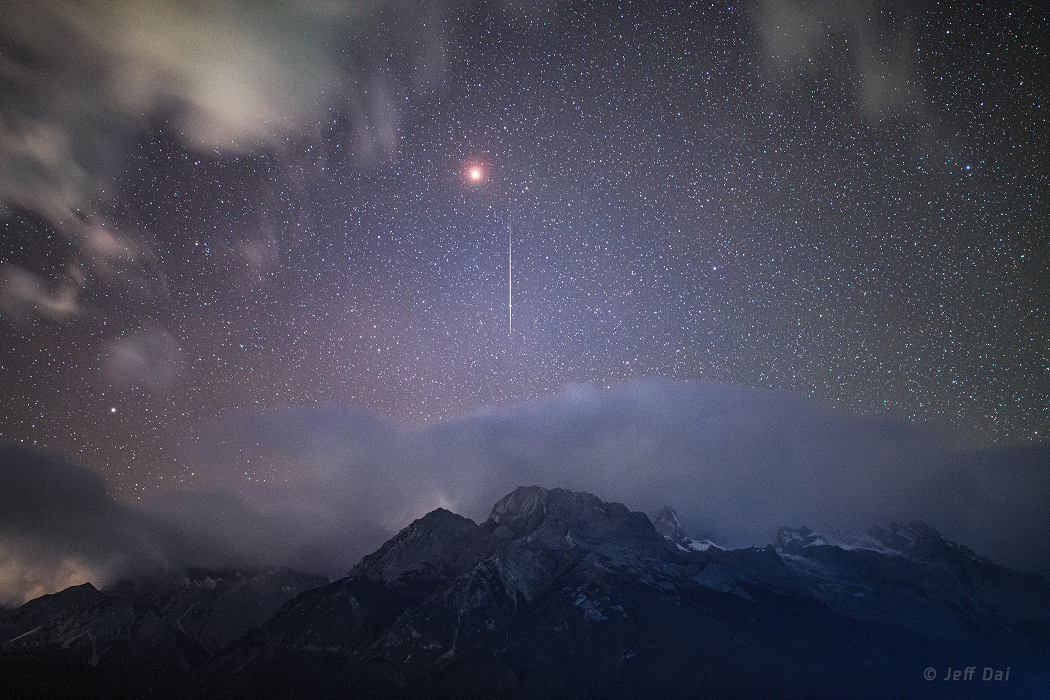
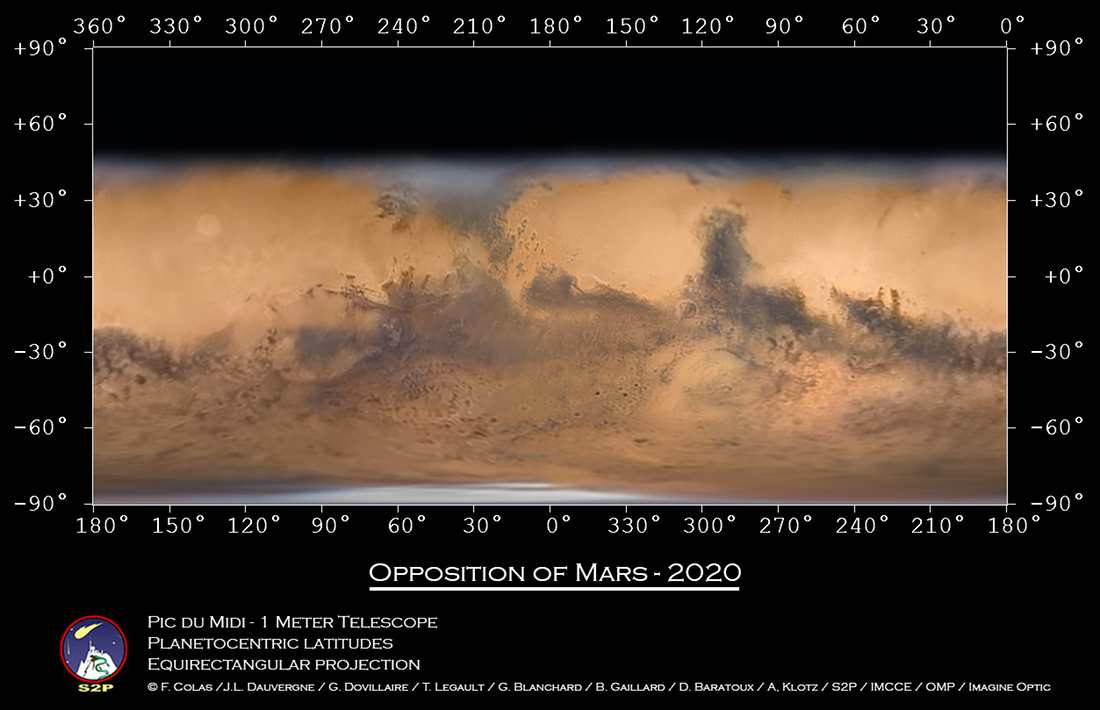
Three very different — and very famous — objects were all captured in a single frame last month. On the upper left is the bright blue Pleiades, perhaps the most famous cluster of stars on the night sky. The Pleiades (M45) is about 450 light years away and easily found a few degrees from Orion. On the upper right is the expansive Andromeda Galaxy, perhaps the most famous galaxy — external to our own — on the night sky. Andromeda (M31) is one of few objects visible to the unaided eye where you can see light that is millions of years old. In the middle is bright red Mars, perhaps the most famous planet on the night sky. Today Mars is at opposition, meaning that it is opposite the Sun, with the result that it is visible all night long. In the foreground is an ancient tomb in the Phygrian Valley in Turkey. The tomb, featuring two stone lions, is an impressive remnant of a powerful civilization that lived thousands of years ago. Mars, currently near its brightest, can be easily found toward the east just after sunset. [via NASA] https://ift.tt/3lEYd1x

Descending Toward Asteroid Bennu

What would it be like to land on an asteroid? Although no human has yet done it, NASA’s robotic OSIRIS-REx spacecraft is scheduled to attempt to touch the surface of asteroid 101955 Bennu next week. The goal is to collect a sample from the nearby minor planet for return to Earth for a detailed analysis in 2023. The featured video shows what it looks like to descend toward the 500-meter diamond-shaped asteroid, based on a digital map of Bennu’s rocky surface constructed from image and surface data taken by OSIRIS-REx over the past 1.5 years. The video begins by showing a rapidly spinning Bennu — much faster than its real rotation period of 4.3 hours. After the rotation stops, the virtual camera drops you down to just above the rugged surface and circles a house-sized rock outcrop named Simurgh, with the flatter outcrop Roc visible behind it. If the return sample reaches Earth successfully, it will be scrutinized for organic compounds that might have seeded a young Earth, rare or unusual elements and minerals, and clues about the early history of our Solar System. [via NASA] https://ift.tt/3jRlgG0

Milky Way over the Pinnacles in Australia

What strange world is this? Earth. In the foreground of the featured image are the Pinnacles, unusual rock spires in Nambung National Park in Western Australia. Made of ancient sea shells (limestone), how these human-sized picturesque spires formed remains unknown. In the background, just past the end of the central Pinnacle, is a bright crescent Moon. The eerie glow around the Moon is mostly zodiacal light, sunlight reflected by dust grains orbiting between the planets in the Solar System. Arching across the top is the central band of our Milky Way Galaxy. Many famous stars and nebulas are also visible in the background night sky. The featured 29-panel panorama was taken and composed in 2015 September after detailed planning that involved the Moon, the rock spires, and their corresponding shadows. Even so, the strong zodiacal light was a pleasant surprise. [via NASA] https://ift.tt/36Pnt13

Virgo Cluster Galaxies

Galaxies of the Virgo Cluster are scattered across this deep telescopic field of view. The cosmic scene spans about three Full Moons, captured in dark skies near Jalisco, Mexico, planet Earth. About 50 million light-years distant, the Virgo Cluster is the closest large galaxy cluster to our own local galaxy group. Prominent here are Virgo’s bright elliptical galaxies from the Messier catalog, M87 at the top left, and M84 and M86 seen (bottom to top) below and right of center. M84 and M86 are recognized as part of Markarian’s Chain, a visually striking line-up of galaxies vertically on the right side of this frame. Near the middle of the chain lies an intriguing interacting pair of galaxies, NGC 4438 and NGC 4435, known to some as Markarian’s Eyes. Of course giant elliptical galaxy M87 dominates the Virgo cluster. It’s the home of a super massive black hole, the first black hole ever imaged by planet Earth’s Event Horizon Telescope. [via NASA] https://ift.tt/3iJGfcf

The Very Large Array at Moonset

An inspirational sight, these giant dish antennas of the Karl G. Jansky Very Large Array (VLA) rise above the New Mexico desert at moonset. Mounted on piers but transportable on railroad tracks to change the VLA’s configuration, its 27 operating antennas are each house-sized (25 meters across) and can be organized into an array spanning the size of a city (35 kilometers). A prolific radio astronomy workhorse, the VLA has been used to discover water on planet Mercury, radio-bright coronae around stars, micro-quasars in our Galaxy, gravitationally-induced Einstein rings around distant galaxies, and radio counterparts to cosmologically distant gamma-ray bursts. Its vast size has allowed astronomers to study the details of radio galaxies, super-fast cosmic jets, and map the center of our own Milky Way. Now 40 years since its dedication the VLA has been used in more than 14,000 observing projects and contributed to more than 500 Ph.D. dissertations. On October 10, the National Radio Astronomy Observatory will host a day-long online celebration of the VLA at 40 featuring virtual tours and presentations on the history, operations, science, and future of the Very Large Array. [via NASA] https://ift.tt/33GEd8v

Mare Frigoris

Lighter than typically dark, smooth, mare the Mare Frigoris lies in the far lunar north. Also known as the Sea of Cold, it stretches across the familiar lunar nearside in this close up of the waxing gibbous Moon’s north polar region. Dark-floored, 95 kilometer wide crater Plato is just left of the center. Sunlit peaks of the lunar Alps (Montes Alpes) are highlighted below and right of Plato, between the more southern Mare Imbrium (Sea of Rains) and Mare Frigoris. The prominent straight feature cutting through the mountains is the lunar Alpine Valley (Vallis Alpes). Joining the Mare Imbrium and Mare Frigoris, the lunar valley is about 160 kilometers long and up to 10 kilometers wide. [via NASA] https://ift.tt/3jSs9GQ