Noctilucent Clouds, Reflections, and Silhouettes

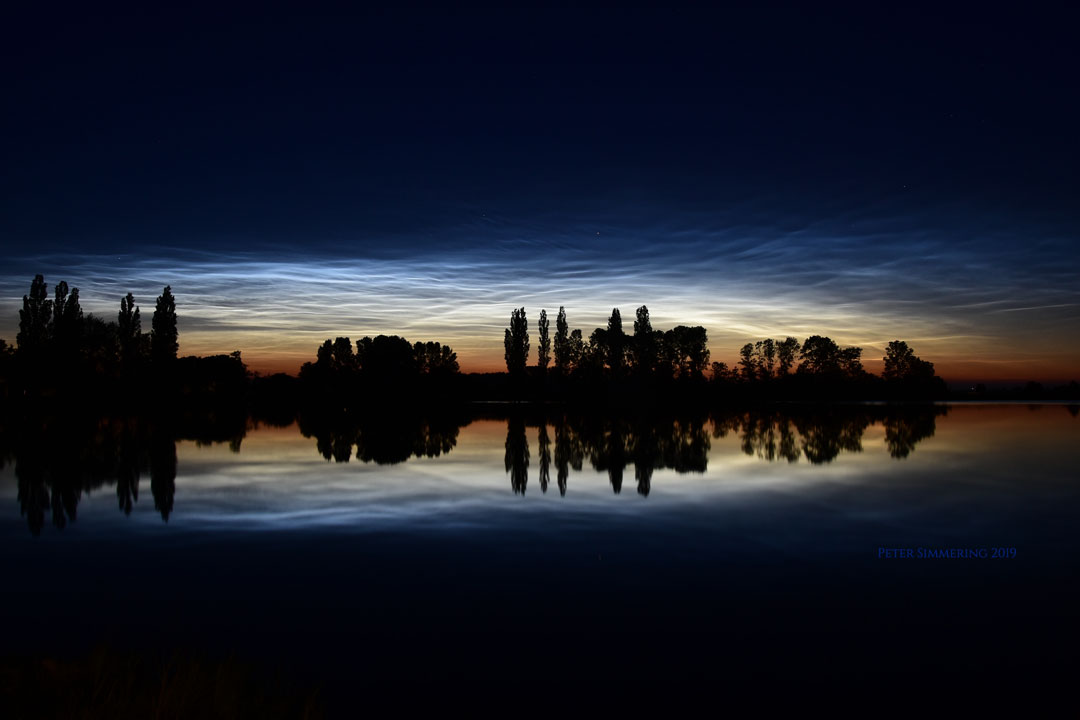
Sometimes it’s night on the ground but day in the air. As the Earth rotates to eclipse the Sun, sunset rises up from the ground. Therefore, at sunset on the ground, sunlight still shines on clouds above. Under usual circumstances, a pretty sunset might be visible, but unusual noctilucent clouds float so high up they can be seen well after dark. Normally too dim to be seen, they may become visible just after sunset during the summer when illuminated by sunlight from below. Noctilucent clouds are the highest clouds known and thought to be part of polar mesospheric clouds. Featured here as they appeared two weeks ago, a network of noctilucent clouds was captured not only in the distant sky but in reflection from a small lake just north of Zwolle, Netherlands, with trees in stark silhouette across the horizon. Unusually bright noctilucent clouds continue to appear over much of northern Europe. Much about noctilucent clouds has been discovered only over the past decade, while how they form and evolve remains a topic of active research. [via NASA] https://ift.tt/2J0jhha
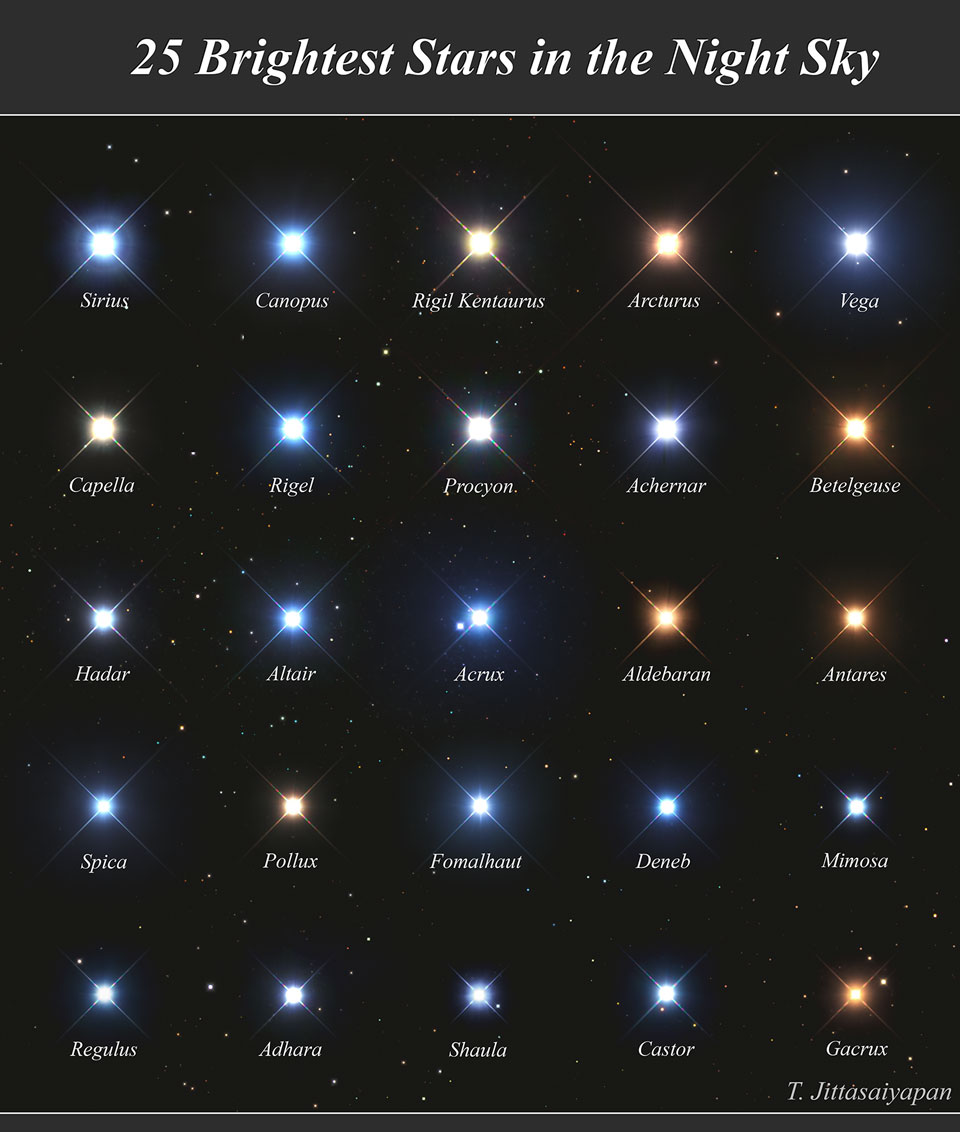
25 Brightest Stars in the Night Sky

Do you know the names of some of the brightest stars? It’s likely that you do, even though some bright stars have names so old they date back to near the beginning of written language. Many world cultures have their own names for the brightest stars, and it is culturally and historically important to remember them. In the interest of clear global communication, however, the International Astronomical Union (IAU) has begun to designate standardized star names. Featured above in true color are the 25 brightest stars in the night sky, currently as seen by humans, coupled with their IAU-recognized names. Some star names have interesting meanings, including Sirius («the scorcher» in Latin), Vega («falling» in Arabic), and Antares («rival to Mars» in Greek). It’s also likely that other of these bright star names are not familiar to you, even though familiar Polaris is too dim to make this list. [via NASA] https://go.nasa.gov/2FI27Ez

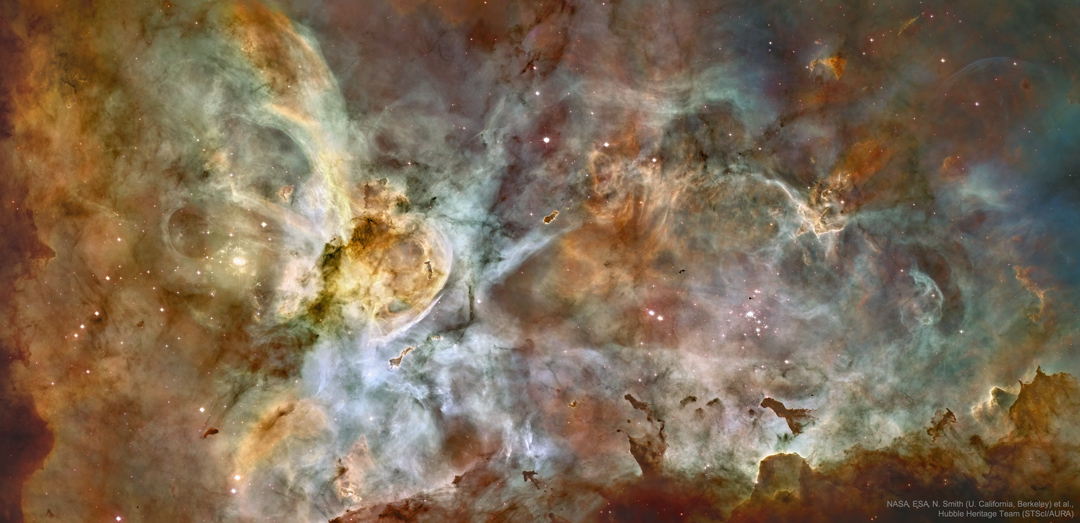
Carina Nebula Panorama from Hubble

How do violent stars affect their surroundings? To help find out, astronomers created a 48-frame high-resolution, controlled-color panorama of the center of the Carina Nebula, one of the largest star forming regions on the night sky. The featured image, taken in 2007, was the most detailed image of the Carina Nebula yet taken. Cataloged as NGC 3372, the Carina Nebula is home to streams of hot gas, pools of cool gas, knots of dark globules, and pillars of dense dusty interstellar matter. The Keyhole Nebula, visible left of center, houses several of the most massive stars known. These large and violent stars likely formed in dark globules and continually reshape the nebula with their energetic light, outflowing stellar winds, and ultimately by ending their lives in supernova explosions. Visible to the unaided eye, the entire Carina Nebula spans over 450 light years and lies about 8,500 light-years away toward the constellation of Ship’s Keel (Carina). [via NASA] https://go.nasa.gov/2N5te2s

Sunset Analemma

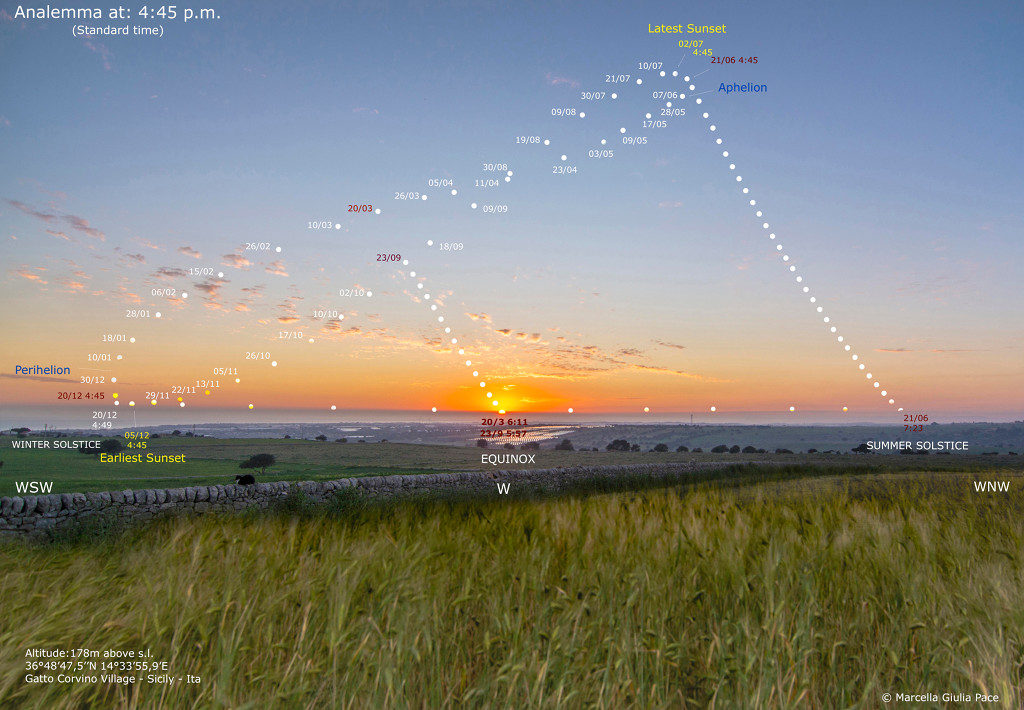
Today, the solstice is at 15:54 Universal Time, the Sun reaching the northernmost declination in its yearly journey through planet Earth’s sky. A June solstice marks the astronomical beginning of summer in the northern hemisphere and winter in the south. It also brings the north’s longest day, the longest period between sunrise and sunset. In fact the June solstice sun is near the top, at the most northern point in the analemma or figure 8 curve traced by the position of the Sun in this composite photo. The analemma was created (video) from images taken every 10 days at the same time from June 21, 2018 and June 7, 2019. The time was chosen to be the year’s earliest sunset near the December solstice, so the analemma’s lowest point just kisses the unobstructed sea horizon at the left. Sunsets arranged along the horizon toward the right (north) are centered on the sunset at the September equinox and end with sunset at the June solstice. [via NASA] https://go.nasa.gov/2NaEZV0

A View Toward M106

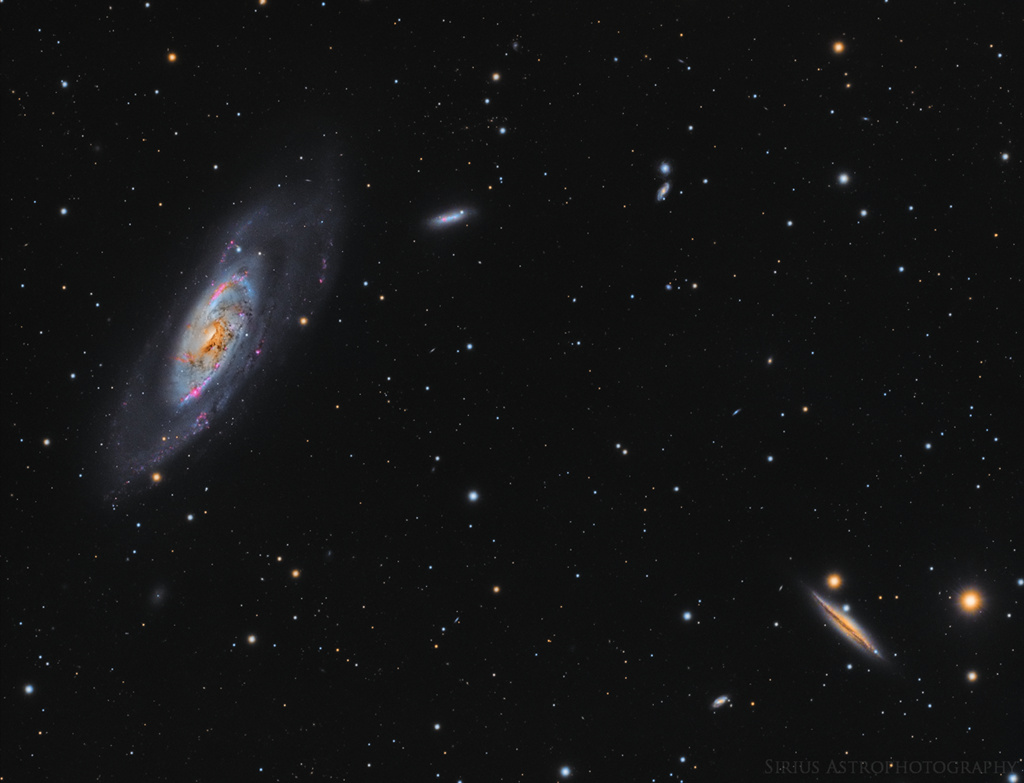
Big, bright, beautiful spiral, Messier 106 dominates this cosmic vista. The nearly two degree wide telescopic field of view looks toward the well-trained constellation Canes Venatici, near the handle of the Big Dipper. Also known as NGC 4258, M106 is about 80,000 light-years across and 23.5 million light-years away, the largest member of the Canes II galaxy group. For a far away galaxy, the distance to M106 is well-known in part because it can be directly measured by tracking this galaxy’s remarkable maser, or microwave laser emission. Very rare but naturally occurring, the maser emission is produced by water molecules in molecular clouds orbiting its active galactic nucleus. Another prominent spiral galaxy on the scene, viewed nearly edge-on, is NGC 4217 below and right of M106. The distance to NGC 4217 is much less well-known, estimated to be about 60 million light-years. [via NASA] https://go.nasa.gov/2Y3W18C

Our Galaxys Magnetic Center

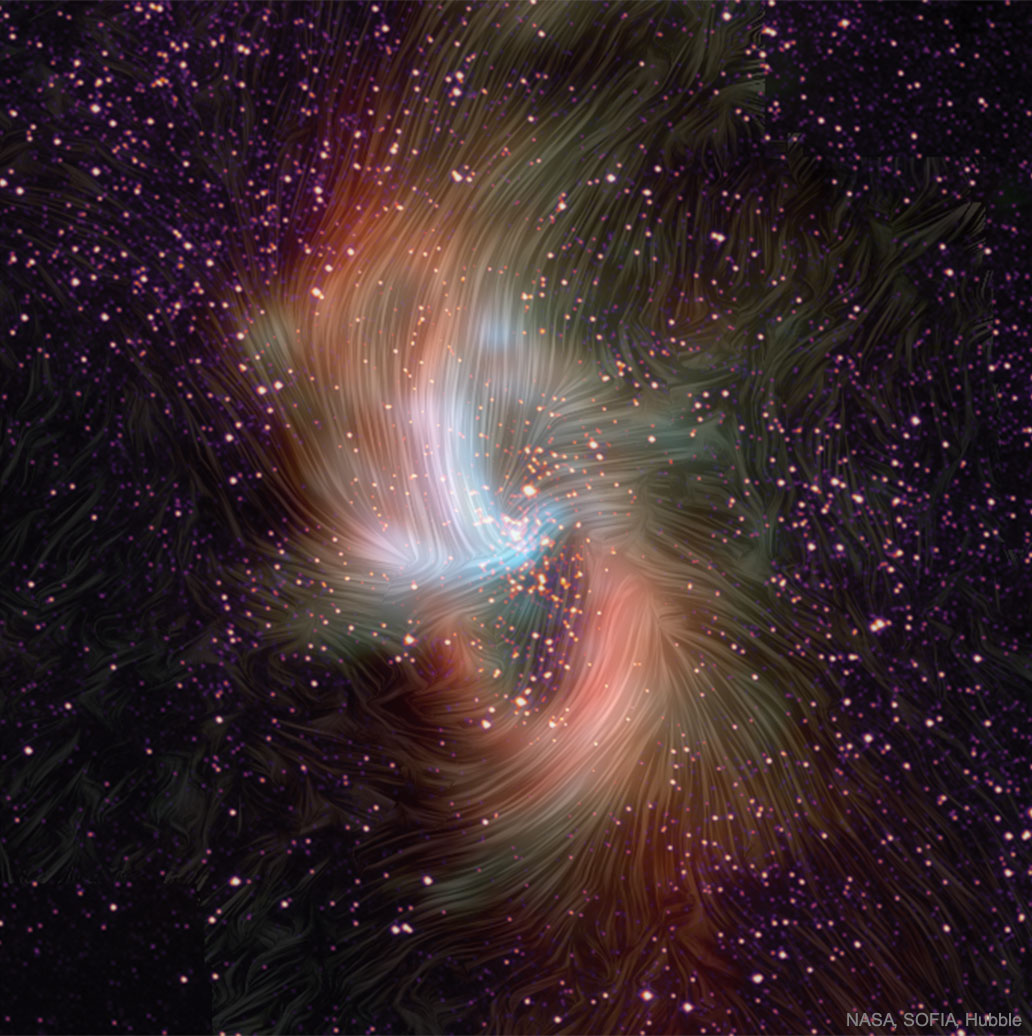
What’s the magnetic field like in the center of our Milky Way Galaxy? To help find out, NASA’s SOFIA — an observatory flying in a modified 747 — imaged the central region with an instrument known as HAWC+. HAWC+ maps magnetism by observing polarized infrared light emitted by elongated dust grains rotating in alignment with the local magnetic field. Now at our Milky Way’s center is a supermassive black hole with a hobby of absorbing gas from stars it has recently destroyed. Our galaxy’s black hole, though, is relatively quiet compared to the absorption rate of the central black holes in active galaxies. The featured image gives a clue as to why — a surrounding magnetic field may either channel gas into the black hole — which lights up its exterior, or forces gas into an accretion-disk holding pattern, causing it to be less active — at least temporarily. Inspection of the featured image — appearing perhaps like a surreal mashup of impasto art and gravitational astrophysics — brings out this telling clue by detailing the magnetic field in and around a dusty ring surrounding Sagittarius A*, the black hole in our Milky Way’s center. [via NASA] https://go.nasa.gov/2Iq6CFx

Strawberry Moon over the Temple of Poseidon

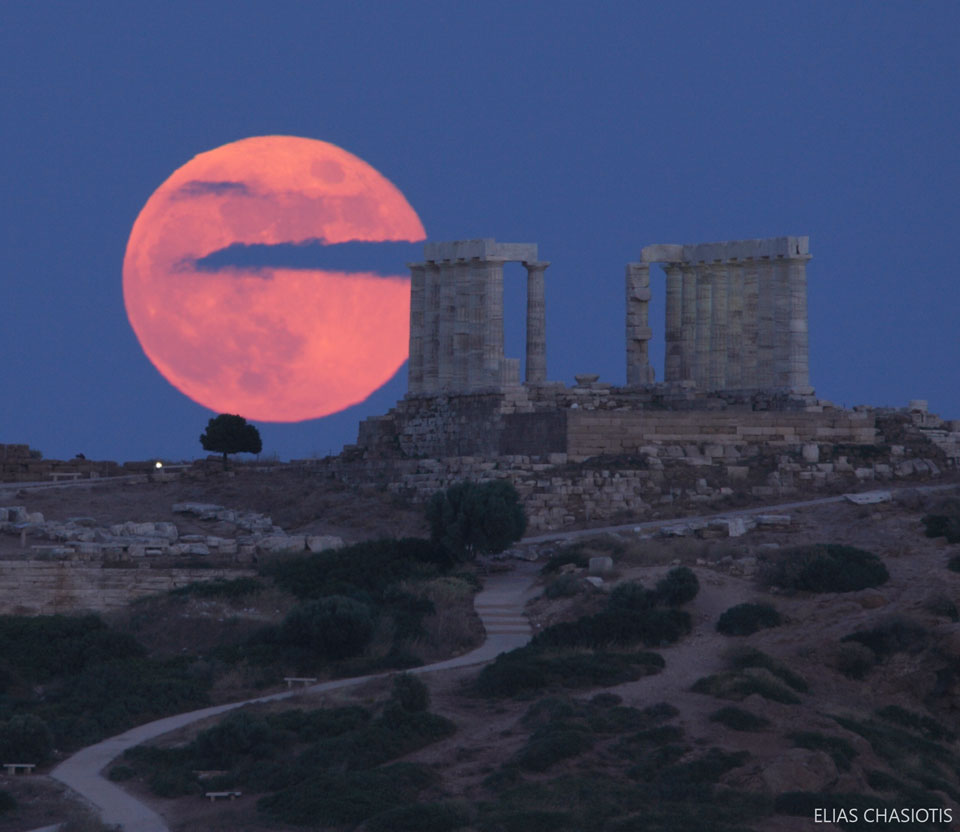
Did you see the full moon last night? If not, tonight’s nearly full moon should be almost as good. Because full moons are opposite the Sun, they are visible in the sky when the Sun is not — which should be nearly all night long tonight, clouds permitting. One nickname for June’s full moon is the Strawberry Moon, named for when wild strawberries start to ripen in parts of Earth’s northern hemisphere. Different cultures around the globe give this full moon different names, though, including Honey Moon and Rose Moon. In the foreground of this featured image, taken yesterday in Cape Sounion, Greece, is the 2,400 year-old Temple of Poseidon. Next month will the 50th anniversary of the time humans first landed on the Moon. [via NASA] https://go.nasa.gov/2KWBIWJ

Milky Way over Pyramid of the Feathered Serpent

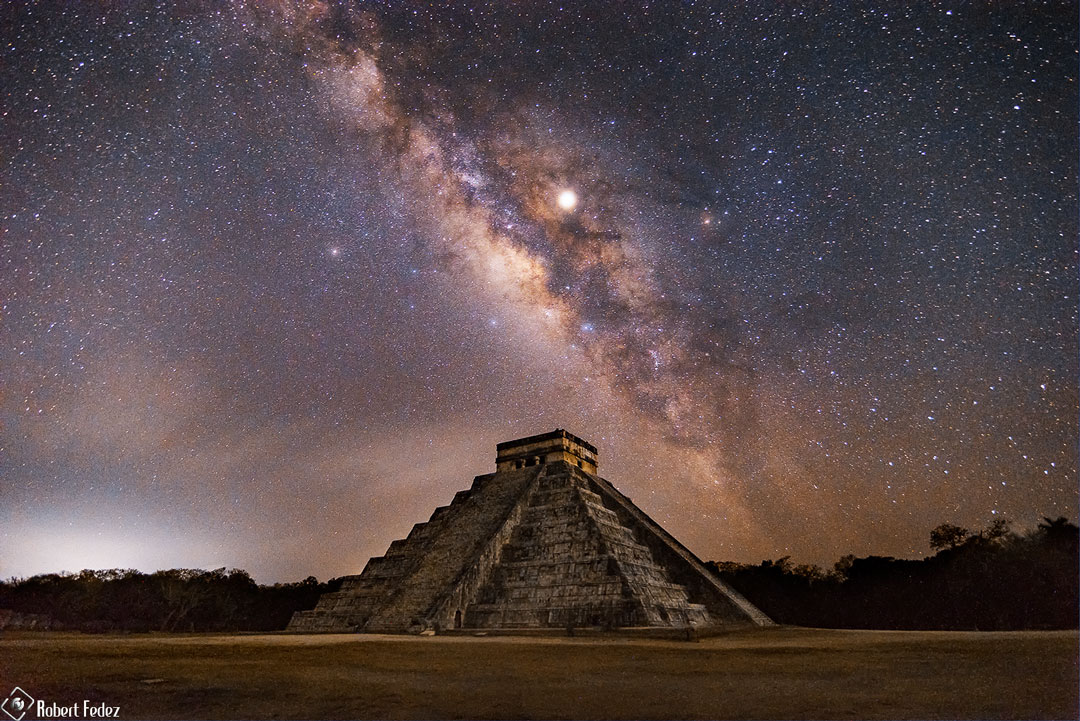
To see the feathered serpent descend the Mayan pyramid requires exquisite timing. You must visit El Castillo — in Mexico’s Yucatán Peninsula — near an equinox. Then, during the late afternoon if the sky is clear, the pyramid’s own shadows create triangles that merge into the famous illusion of the slithering viper. Also known as the Temple of Kukulkan, the impressive step-pyramid stands 30 meters tall and 55 meters wide at the base. Built up as a series of square terraces by the pre-Columbian civilization between the 9th and 12th century, the structure can be used as a calendar and is noted for astronomical alignments. To see the central band of our Milky Way Galaxy descend overhead the Mayan pyramid, however, requires less exquisite timing. Even the ancient Mayans might have been impressed, though, to know that the exact positions of the Milky Way, Saturn (left) and Jupiter (right) in the featured image give it a time stamp more specific than equinox — in fact 2019 April 7 at 5 am. [via NASA] https://go.nasa.gov/2IndBPr

Unusual Mountain Ahuna Mons on Asteroid Ceres

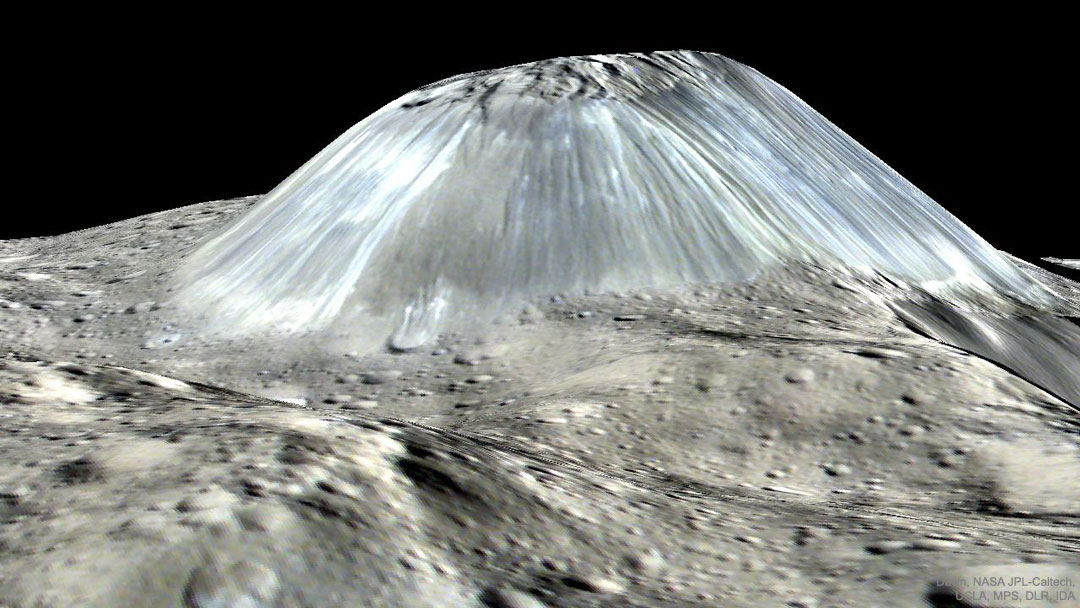
What created this unusual mountain? There is a new theory. Ahuna Mons is the largest mountain on the largest known asteroid in our Solar System, Ceres, which orbits our Sun in the main asteroid belt between Mars and Jupiter. Ahuna Mons, though, is like nothing that humanity has ever seen before. For one thing, its slopes are garnished not with old craters but young vertical streaks. The new hypothesis, based on numerous gravity measurements, holds that a bubble of mud rose from deep within the dwarf planet and pushed through the icy surface at a weak point rich in reflective salt — and then froze. The bright streaks are thought to be similar to other recently surfaced material such as visible in Ceres’ famous bright spots. The featured double-height digital image was constructed from surface maps taken of Ceres in 2016 by the robotic Dawn mission. Successfully completing its mission in 2018, Dawn continues to orbit Ceres even though it has exhausted the fuel needed to keep its antennas pointed toward Earth. [via NASA] https://go.nasa.gov/2ZqRu06

Stereo Helene

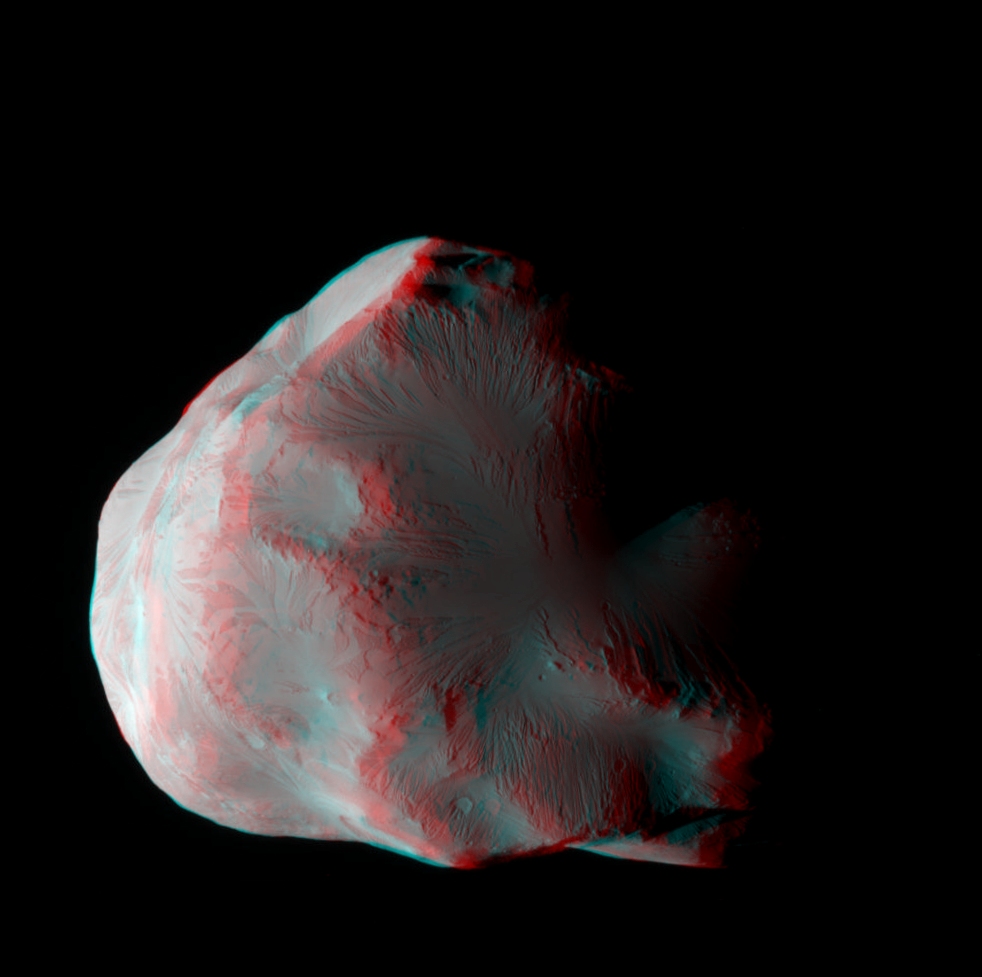
Get out your red/blue glasses and float next to Helene, small, icy moon of Saturn. Appropriately named, Helene is one of four known Trojan moons, so called because it orbits at a Lagrange point. A Lagrange point is a gravitationally stable position near two massive bodies, in this case Saturn and larger moon Dione. In fact, irregularly shaped ( about 36 by 32 by 30 kilometers) Helene orbits at Dione’s leading Lagrange point while brotherly ice moon Polydeuces follows at Dione’s trailing Lagrange point. The sharp stereo anaglyph was constructed from two Cassini images captured during a close flyby in 2011. It shows part of the Saturn-facing hemisphere of Helene mottled with craters and gully-like features. [via NASA] https://go.nasa.gov/2ReWOkr