Comet 2022 E3 ZTF

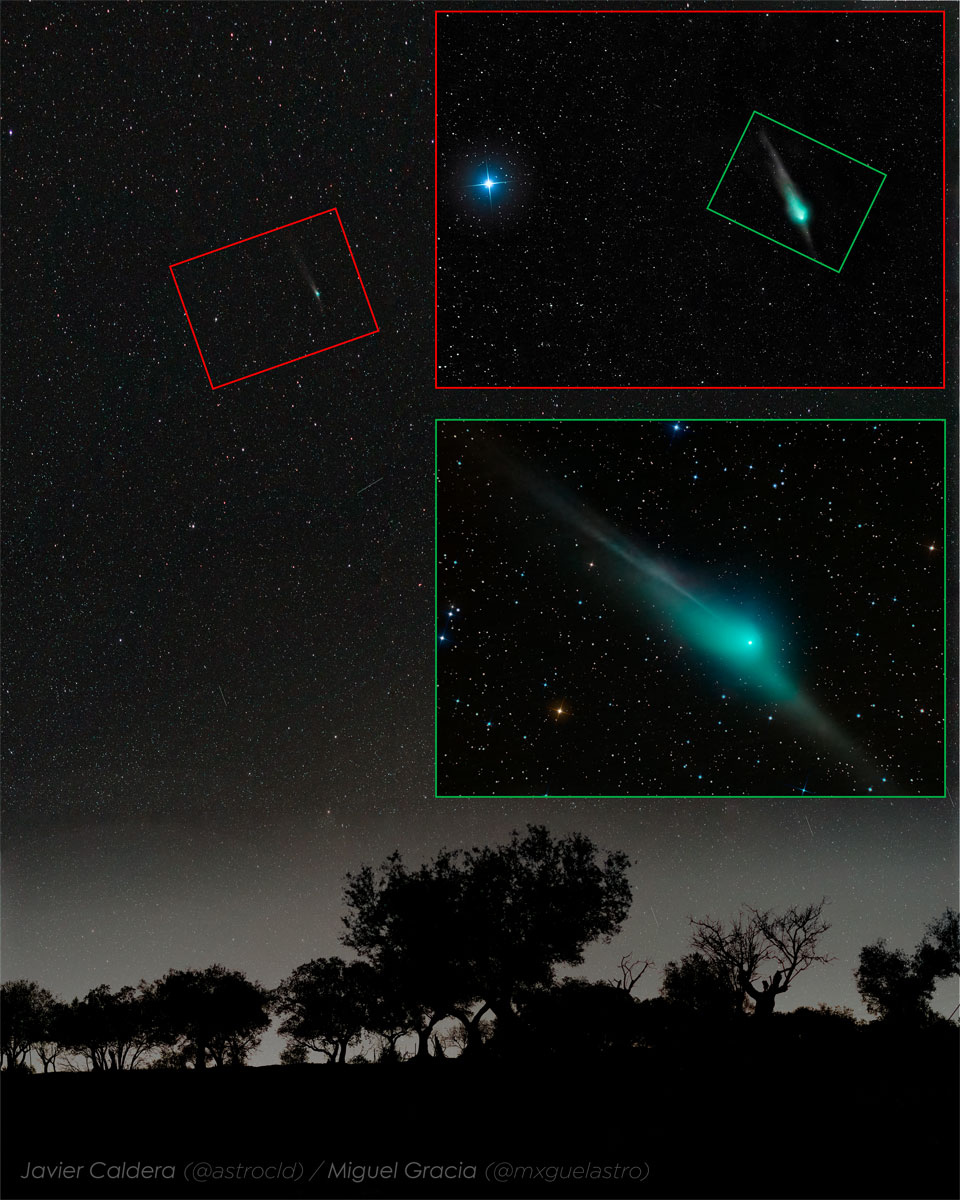
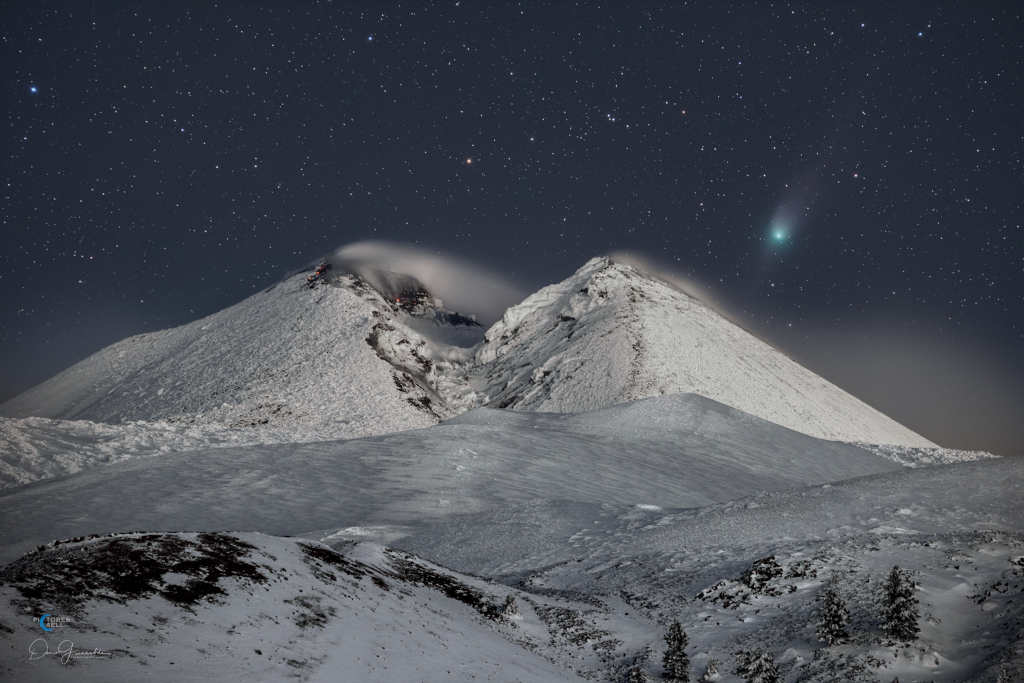
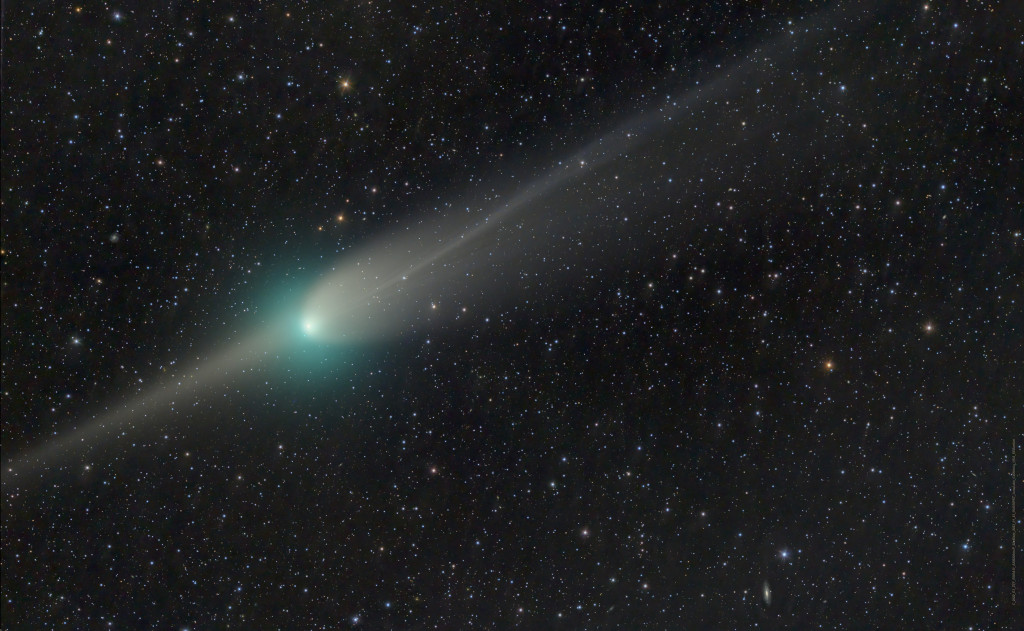
Comet C/2022 E3 (ZTF) was discovered by astronomers using the wide-field survey camera at the Zwicky Transient Facility this year in early March. Since then the new long-period comet has brightened substantially and is now sweeping across the northern constellation Corona Borealis in predawn skies. It’s still too dim to see without a telescope though. But this fine telescopic image from December 19 does show the comet’s brighter greenish coma, short broad dust tail, and long faint ion tail stretching across a 2.5 degree wide field-of-view. On a voyage through the inner Solar System comet 2022 E3 will be at perihelion, its closest to the Sun, in the new year on January 12 and at perigee, its closest to our fair planet, on February 1. The brightness of comets is notoriously unpredictable, but by then C/2022 E3 (ZTF) could become only just visible to the eye in dark night skies. [via NASA] https://ift.tt/agTtAC8

Cassini Looks Out from Saturn

This is what Saturn looks like from inside the rings. In 2017, for the first time, NASA directed the Cassini spacecraft to swoop between Saturn and its rings. During the dive, the robotic spacecraft took hundreds of images showing unprecedented detail for structures in Saturn’s atmosphere. Looking back out, however, the spacecraft was also able to capture impressive vistas. In the featured image, taken a few hours before closest approach, Saturn’s unusual northern hexagon is seen surrounding the North Pole. Saturn’s B ring is the closest visible, while the dark Cassini Division separates B from the outer A. A close inspection will find the two small moons that shepherd the F-ring, the farthest ring discernable. A few months after this image was taken — and after more than a decade of exploration and discovery — the Cassini spacecraft ran low on fuel and was directed to enter Saturn’s atmosphere, where it surely melted. [via NASA] https://ift.tt/yjrm2uv

NGC 1365: Majestic Island Universe

Barred spiral galaxy NGC 1365 is truly a majestic island universe some 200,000 light-years across. Located a mere 60 million light-years away toward the faint but heated constellation Fornax, NGC 1365 is a dominant member of the well-studied Fornax Cluster of galaxies. This impressively sharp color image shows the intense, reddish star forming regions near the ends of central bar and along the spiral arms, with details of the obscuring dust lanes cutting across the galaxy’s bright core. At the core lies a supermassive black hole. Astronomers think NGC 1365’s prominent bar plays a crucial role in the galaxy’s evolution, drawing gas and dust into a star-forming maelstrom and ultimately feeding material into the central black hole. [via NASA] https://ift.tt/OAXyCne

Sun Halo at Sixty three Degrees North

Happy Solstice! Today is the December solstice, marking an astronomical beginning of summer in the southern hemisphere and winter in the north. On its yearly trek through planet Earth’s skies, at this solstice the Sun reaches its southern most declination, 23.5 degrees south, at 21:48 UTC. About 4 days ago the Sun was near this seasonal southern limit and so only just above the horizon at local noon over Ostersund in central Sweden. This view looking over the far northern lakeside city finds the midday Sun with a beautiful solar ice halo. Naturally occurring atmospheric ice crystals can produce the tantalizing halo displays, refracting and reflecting the sunlight through their hexagonal geometry. Still, with the Sun low and near the horizon in the clear sky, likely sources of the ice crystals producing this intense halo are snow cannons. Operating at a local ski area, the snowmaking machines create a visible plume at the top of the nearby island Froson toward the right side of the panorama. [via NASA] https://apod.nasa.gov/apod/ap221221.html

Thors Helmet

Thor not only has his own day (Thursday), but a helmet in the heavens. Popularly called Thor’s Helmet, NGC 2359 is a hat-shaped cosmic cloud with wing-like appendages. Heroically sized even for a Norse god, Thor’s Helmet is about 30 light-years across. In fact, the cosmic head-covering is more like an interstellar bubble, blown with a fast wind from the bright, massive star near the bubble’s center. Known as a Wolf-Rayet star, the central star is an extremely hot giant thought to be in a brief, pre-supernova stage of evolution. NGC 2359 is located about 15,000 light-years away toward the constellation of the Great Overdog. This remarkably sharp image is a mixed cocktail of data from narrowband filters, capturing not only natural looking stars but details of the nebula’s filamentary structures. The star in the center of Thor’s Helmet is expected to explode in a spectacular supernova sometime within the next few thousand years. [via NASA] https://ift.tt/n3k0S4y

The Tadpole Nebula in Gas and Dust

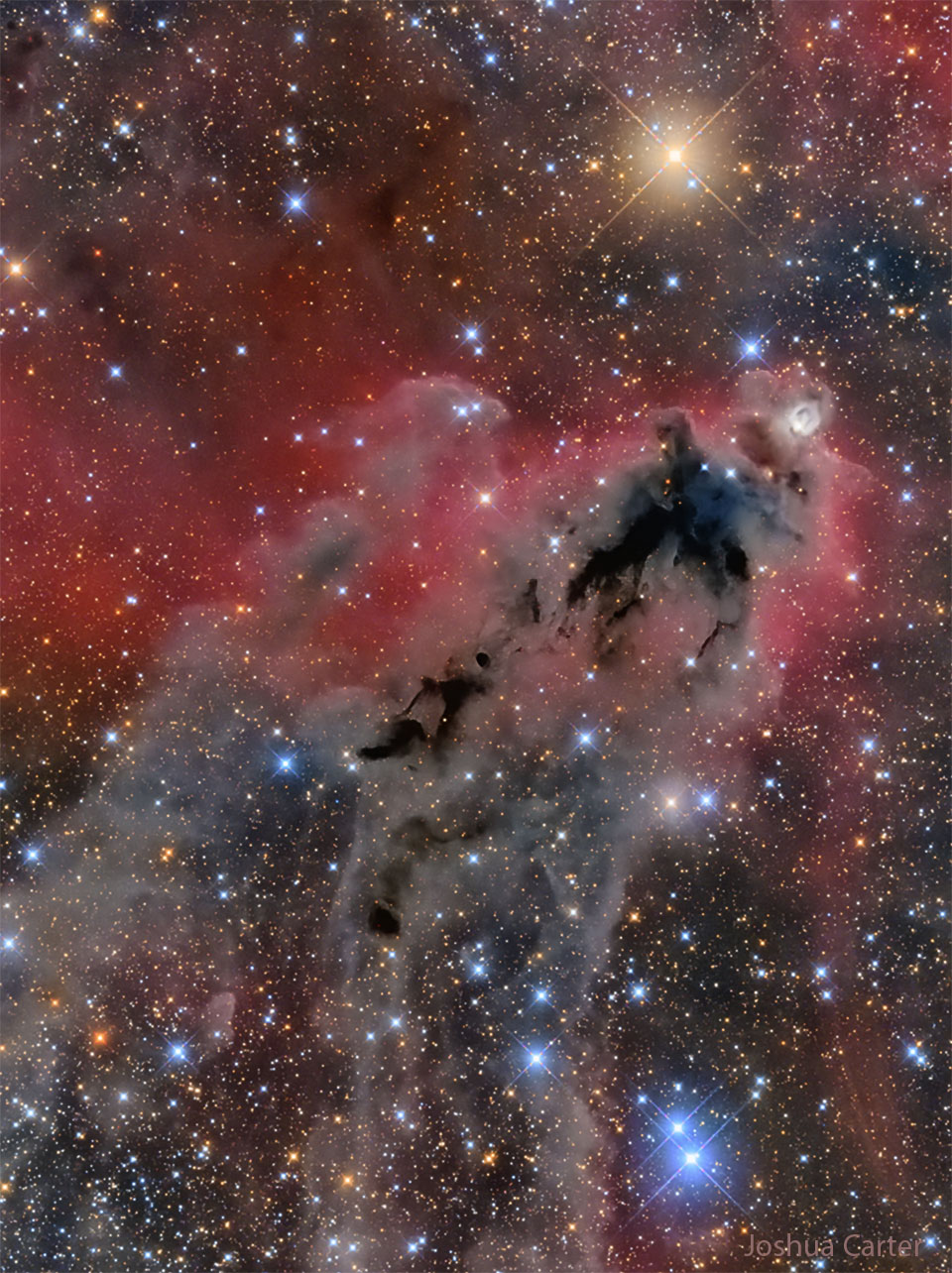
What’s causing the commotion in the Tadpole Nebula? Star formation. Dusty emission in the Tadpole Nebula, IC 410, lies about 12,000 light-years away in the northern constellation of the Charioteer (Auriga). The cloud of glowing gas is over 100 light-years across, sculpted by stellar winds and radiation from embedded open star cluster NGC 1893. Formed in the interstellar cloud a mere 4 million years ago, bright newly formed cluster stars are seen all around the star-forming nebula. Notable on the lower-right of the featured image are two relatively dense streamers of material trailing away from the nebula’s central regions. Potentially sites of ongoing star formation in IC 410, these cosmic tadpole shapes are about 10 light-years long. The image was processed highlighting the emission from sulfur (red), hydrogen (green), and oxygen (blue) gas — but with the stars digitally removed. [via NASA] https://ift.tt/d6uoeTt

The 25 Brightest Stars in the Night Sky

Do you know the names of some of the brightest stars? It’s likely that you do, even though some bright stars have names so old they date back to near the beginning of written language. Many world cultures have their own names for the brightest stars, and it is culturally and historically important to remember them. In the interest of clear global communication, however, the International Astronomical Union (IAU) has begun to designate standardized star names. Featured here in true color are the 25 brightest stars in the night sky, currently as seen by humans, coupled with their IAU-recognized names. Some star names have interesting meanings, including Sirius («the scorcher» in Latin), Vega («falling» in Arabic), and Antares («rival to Mars» in Greek). You are likely even familiar with the name of at least one star too dim to make this list: Polaris. [via NASA] https://ift.tt/zo9qE5v

Apollo 17 VIP Site Anaglyph

Get out your red/blue glasses and check out this stereo scene from Taurus-Littrow valley on the Moon! The color anaglyph features a detailed 3D view of Apollo 17’s Lunar Rover in the foreground — behind it lies the Lunar Module and distant lunar hills. Because the world was going to be able to watch the Lunar Module’s ascent stage liftoff via the rover’s TV camera, this parking place was also known as the VIP Site. Fifty years ago, in December of 1972, Apollo 17 astronauts Eugene Cernan and Harrison Schmitt spent about 75 hours on the Moon, while colleague Ronald Evans orbited overhead. The crew returned with 110 kilograms of rock and soil samples, more than from any of the other lunar landing sites. Cernan and Schmitt are still the last to walk (or drive) on the Moon. [via NASA] https://ift.tt/ibf0RlJ

The Geminid

Returning from beyond the Moon, on December 11 the Orion spacecraft entered Earth’s atmosphere at almost 11 kilometers per second. That’s half the speed of the grain of dust that created this long fireball meteor when it entered the atmosphere on December 13, near the peak of the annual Geminid meteor shower. As our fair planet makes its yearly pass through the dust trail of mysterious asteroid 3200 Phaethon, the parallel tracks of all Geminid meteors appear to radiate from a point in the constellation Gemini. But the twin stars of Gemini hide just behind the trees on the left in this night skyscape from the beautiful Blue Moon Valley, Yunnan, China. Reflected in the still waters of the mountain lake, stars of the constellation Orion are rising near center. Captured before moonrise, dazzling Mars is still the brightest celestial beacon in the scene. [via NASA] https://ift.tt/gylTnz6

Full Moon, Full Mars

On December 8 a full Moon and a full Mars were close, both bright and opposite the Sun in planet Earth’s sky. In fact Mars was occulted, passing behind the Moon when viewed from some locations across Europe and North America. Seen from the city of Kosice in eastern Slovakia, the lunar occultation of Mars happened just before sunrise. The tantalizing spectacle was recorded in this telescopic timelapse sequence of exposures. It took about an hour for the Red Planet to disappear behind the lunar disk and then reappear as a warm-hued full Moon, the last full Moon of 2022, sank toward the western horizon. The next lunar occultation of bright planet Mars will be in the new year on January 3, when the Moon is in a waxing gibbous phase. Lunar occultations are only ever visible from a fraction of the Earth’s surface, though. The January 3 occultation of Mars will be visible from parts of the South Atlantic, southern Africa, and the Indian Ocean. [via NASA] https://ift.tt/QpwuXj1