N11: Star Clouds of the LMC

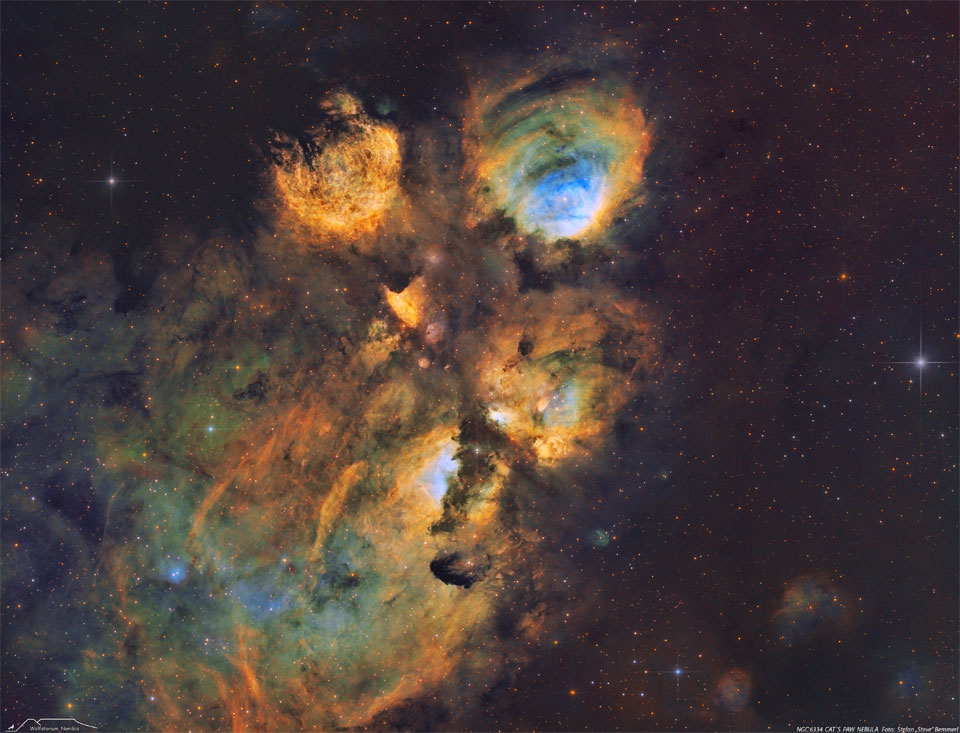
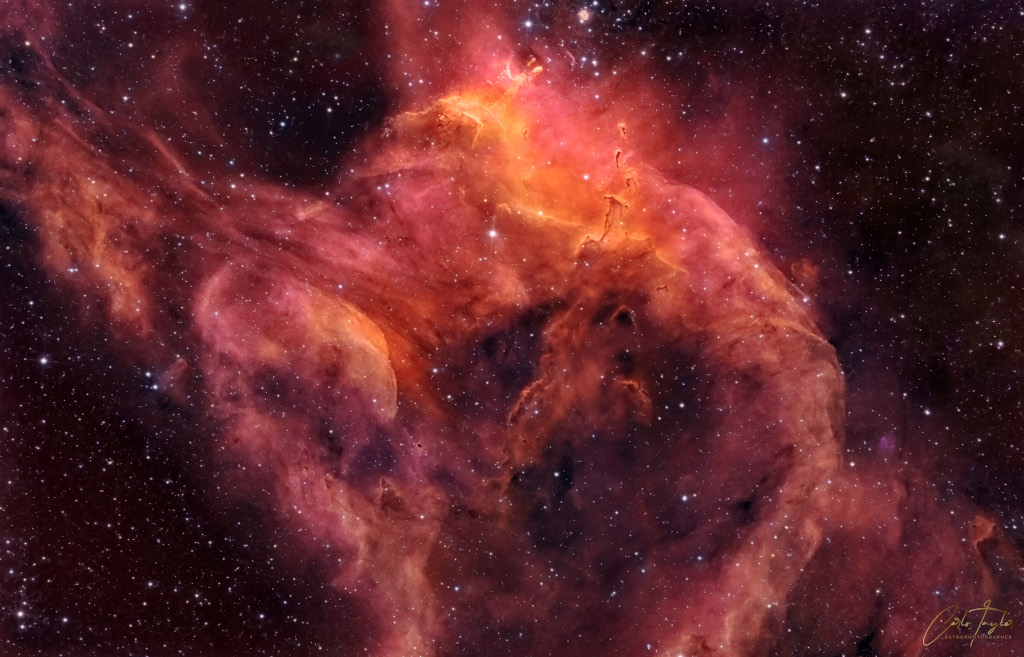
Massive stars, abrasive winds, mountains of dust, and energetic light sculpt one of the largest and most picturesque regions of star formation in the Local Group of Galaxies. Known as N11, the region is visible on the upper right of many images of its home galaxy, the Milky Way neighbor known as the Large Magellanic Cloud (LMC). The featured image was taken for scientific purposes by the Hubble Space Telescope and reprocessed for artistry. Although the section imaged above is known as NGC 1763, the entire N11 emission nebula is second in LMC size only to the Tarantula Nebula. Compact globules of dark dust housing emerging young stars are also visible around the image. A recent study of variable stars in the LMC with Hubble has helped to recalibrate the distance scale of the observable universe, but resulted in a slightly different scale than found using the pervasive cosmic microwave background. [via NASA] https://ift.tt/riEGUJL

A Space Station Crosses a Busy Sun

Typically, the International Space Station is visible only at night. Slowly drifting across the night sky as it orbits the Earth, the International Space Station (ISS) can be seen as a bright spot several times a year from many locations. The ISS is then visible only just after sunset or just before sunrise because it shines by reflected sunlight — once the ISS enters the Earth’s shadow, it will drop out of sight. The only occasion when the ISS is visible during the day is when it passes right in front of the Sun. Then, it passes so quickly that only cameras taking short exposures can visually freeze the ISS’s silhouette onto the background Sun. The featured picture did exactly that — it is actually a series of images taken earlier this month from Beijing, China with perfect timing. This image series was later combined with separate images taken at nearly the same time but highlighting the texture and activity on the busy Sun. The solar activity included numerous gaseous prominences seen around the edge, highlighted in red, filaments seen against the Sun’s face, and a dark sunspot. [via NASA] https://ift.tt/LH097GR

Shadows at the Moons South Pole

Was this image of the Moon’s surface taken with a microscope? No — it’s a multi-temporal illumination map made with a wide-angle camera. To create it, the Lunar Reconnaissance Orbiter spacecraft collected 1,700 images over a period of 6 lunar days (6 Earth months), repeatedly covering an area centered on the Moon’s south pole from different angles. The resulting images were stacked to produce the featured map — representing the percentage of time each spot on the surface was illuminated by the Sun. Remaining convincingly in shadow, the floor of the 19-kilometer diameter Shackleton crater is seen near the map’s center. The lunar south pole itself is at about 9 o’clock on the crater’s rim. Crater floors near the lunar south and north poles can remain in permanent shadow, while mountain tops can remain in nearly continuous sunlight. Useful for future outposts, the shadowed crater floors could offer reservoirs of water-ice, while the sunlit mountain tops offer good locations to collect solar power. [via NASA] https://ift.tt/p6LrAnB

Mars Saturn Conjunction

Fainter stars in the zodiacal constellation Capricornus are scattered near the plane of the ecliptic in this field of view. The two brightest ones at center aren’t stars at all though, but the planets Mars and Saturn. Taken on the morning of April 4, the telescopic snapshot captured their tantalizing close conjunction in a predawn sky, the pair of planets separated by only about 1/3 of a degree. That’s easily less than the apparent width of a Full Moon. Can you tell which planet is which? If you guessed Mars is the redder one , you’d be right. Above Mars, slightly fainter Saturn still shines with a paler yellowish tinge in reflected sunlight. Even at the low magnification, Saturn’s largest and brightest moon Titan can be spotted hugging the planet very closely on the left. [via NASA] https://ift.tt/9lkbriN

Hale-Bopp: The Great Comet of 1997

Only twenty-five years ago, Comet Hale-Bopp rounded the Sun and offered a dazzling spectacle in planet Earth’s night skies. Digitized from the original astrophoto on 35mm color slide film, this classic image of the Great Comet of 1997 was recorded a few days after its perihelion passage on April 1, 1997. Made with a camera and telephoto lens piggy-backed on a small telescope, the 10 minute long, hand-guided exposure features the memorable tails of Hale-Bopp, a whitish dust tail and blue ion tail. Here, the ion tail extends well over ten degrees across the northern sky. In all, Hale-Bopp was reported as visible to the naked eye from late May 1996 through September 1997. Also known as C/1995 O1, Hale-Bopp is recognized as one of the most compositionally pristine comets to pass through the inner Solar System. A visitor from the distant Oort cloud, the comet’s next perihelion passage should be around the year 4380 AD. Do you remember Hale-Bopp? [via NASA] https://ift.tt/6xWBo4u

Messier 24: Sagittarius Star Cloud

Unlike most entries in Charles Messier’s famous catalog of deep sky objects, M24 is not a bright galaxy, star cluster, or nebula. It’s a gap in nearby, obscuring interstellar dust clouds that allows a view of the distant stars in the Sagittarius spiral arm of our Milky Way galaxy. When you gaze at the star cloud with binoculars or small telescope you are looking through a window over 300 light-years wide at stars some 10,000 light-years or more from Earth. Sometimes called the Small Sagittarius Star Cloud, M24’s luminous stars fill this gorgeous starscape. Covering over 3 degrees or the width of 6 full moons in the constellation Sagittarius, the telescopic field of view includes dark markings B92 and B93 just above center, along with other clouds of dust and glowing nebulae toward the center of the Milky Way. [via NASA] https://ift.tt/CM3KBUf

Earendel: A Star in the Early Universe

Is Earendel the farthest star yet discovered? This scientific possibility started when the Hubble Space Telescope observed a huge cluster of galaxies. The gravitational lens effect of this cluster was seen to magnify and distort a galaxy far in the background. This distorted background galaxy — so far away it has a redshift of 6.2 — appears in the featured image as a long red string, while beads on that string are likely to be star clusters.   The galaxy cluster lens creates a line of maximum magnification line where superposed background objects may appear magnified many thousands of times. On the intersection between the galaxy line and the maximum magnification line is one «bead» which shows evidence of originating from a single bright star in the early universe — now named Earendel. Future investigations may include more imaging by Hubble to see how Earendel’s brightness varies, and, quite possibly, by the new James Webb Space Telescope when it becomes operational later this year.  Earendel’s great distance exceeds that of any known stable star — although the star that exploded creating GRB 090423 had a redshift of 8.2. [via NASA] https://ift.tt/BFmsXPC

Seven Sisters versus California

On the upper right, dressed in blue, is the Pleiades. Also known as the Seven Sisters and M45, the Pleiades is one of the brightest and most easily visible open clusters on the sky. The Pleiades contains over 3,000 stars, is about 400 light years away, and only 13 light years across. Surrounding the stars is a spectacular blue reflection nebula made of fine dust. A common legend is that one of the brighter stars faded since the cluster was named. On the lower left, shining in red, is the California Nebula. Named for its shape, the California Nebula is much dimmer and hence harder to see than the Pleiades. Also known as NGC 1499, this mass of red glowing hydrogen gas is about 1,500 light years away. Although about 25 full moons could fit between them, the featured wide angle, deep field image composite has captured them both. A careful inspection of the deep image will also reveal the star forming region IC 348 and the molecular cloud LBN 777 (the Baby Eagle Nebula). [via NASA] https://ift.tt/SrBnDG3

A Vortex Aurora over Iceland

No, the car was not in danger of being vacuumed into space by the big sky vortex. For one reason, the vortex was really an aurora, and since auroras are created by particles striking the Earth from space, they do not create a vacuum. This rapidly developing auroral display was caused by a Coronal Mass Ejection from the Sun that passed by the Earth closely enough to cause a ripple in Earth’s magnetosphere. The upper red parts of the aurora occur over 250 kilometers high with its red glow created by atmospheric atomic oxygen directly energized by incoming particles. The lower green parts of the aurora occur over 100 kilometers high with its green glow created by atmospheric atomic oxygen energized indirectly by collisions with first-energized molecular nitrogen. Below 100 kilometers, there is little atomic oxygen, which is why auroras end abruptly. The concentric cylinders depict a dramatic auroral corona as seen from the side. The featured image was created from a single 3-second exposure taken in mid-March over Lake Myvatn in Iceland. [via NASA] https://ift.tt/Ss83RlN

CMB Dipole: Speeding Through the Universe

Our Earth is not at rest. The Earth moves around the Sun. The Sun orbits the center of the Milky Way Galaxy. The Milky Way Galaxy orbits in the Local Group of Galaxies. The Local Group falls toward the Virgo Cluster of Galaxies. But these speeds are less than the speed that all of these objects together move relative to the cosmic microwave background radiation (CMBR). In the featured all-sky map from the COBE satellite in 1993, microwave light in the Earth’s direction of motion appears blueshifted and hence hotter, while microwave light on the opposite side of the sky is redshifted and colder. The map indicates that the Local Group moves at about 600 kilometers per second relative to this primordial radiation. This high speed was initially unexpected and its magnitude is still unexplained. Why are we moving so fast? What is out there? [via NASA] https://ift.tt/kCVHx2P