Nova Scotia Northern Lights

This almost otherworldly display of northern lights was captured in clear skies during the early hours of March 31 from 44 degrees north latitude, planet Earth. In a five second exposure the scene looks north from Martinique Beach Provincial Park in Nova Scotia, Canada. Stars of the W-shaped constellation Cassiopeia shine well above the horizon, through the red tint of the higher altitude auroral glow. Auroral activity was anticipated by skywatchers alerted to the possibility of stormy space weather by Sun-staring spacecraft. The predicted geomagnetic storm was sparked as a coronal mass ejection, launched from prolific solar active region 2975, impacted our fair planet’s magnetosphere. [via NASA] https://ift.tt/4V0rNlv

Leaning Tower, Active Sun

The natural filter of a hazy atmosphere offered this recognizable architecture and sunset view on March 27. Dark against the solar disk, large sunspots in solar active regions 2975 and 2976 are wedged between the Duomo of Pisa and its famous Leaning Tower. Only one day later, Sun-staring spacecraft watched active region 2975 unleash a frenzy of solar flares along with two coronal mass ejections. The largest impacted the magnetosphere on March 31 triggering a geomagnetic storm and aurorae in high-latitude night skies. On March 30, active region 2975 erupted again with a powerful X-class solar flare that caused a temporary radio blackout on planet Earth. [via NASA] https://ift.tt/BVAjD4T

Exploring the Antennae

Some 60 million light-years away in the southerly constellation Corvus, two large galaxies are colliding. Stars in the two galaxies, cataloged as NGC 4038 and NGC 4039, very rarely collide in the course of the ponderous cataclysm that lasts for hundreds of millions of years. But the galaxies’ large clouds of molecular gas and dust often do, triggering furious episodes of star formation near the center of the cosmic wreckage. Spanning over 500 thousand light-years, this stunning view also reveals new star clusters and matter flung far from the scene of the accident by gravitational tidal forces. The remarkably sharp ground-based image, an accumulation of 88 hours of exposure captured during 2012-2021, follows the faint tidal tails and distant background galaxies in the field of view. The suggestive overall visual appearance of the extended arcing structures gives the galaxy pair, also known as Arp 244, its popular name – The Antennae. [via NASA] https://ift.tt/QUdrJ1a

Animation: Odd Radio Circles

What do you call a cosmic puzzle that no one expected to see? In this case, Odd Radio Circles, aka ORCs. ORC-1 typifies the enigmatic five objects, only visible at radio frequencies, that were serendipitously discovered in 2019 using the new Australian SKA Pathfinder radio array. The final image in the featured video uses 2021 data from the South African MeerKAT array to reveal more detail. The radio data, assigned turquoise colors, are combined with a Dark Energy Survey optical/IR map. The animated artist’s illustration explores just one idea about the ORCs’ origins. If two supermassive black holes merge in the center of a galaxy, the associated shockwaves could generate rings of radio radiation. These grow to fill the video frame. The video zooms out so the expansion the ORC can be tracked until it is about a million light-years across. Fortunately, the up-coming Square Kilometer Array can help test this and other promising scenarios. [via NASA] https://ift.tt/h1R8Atk

Venus and Mars: Passing in the Night

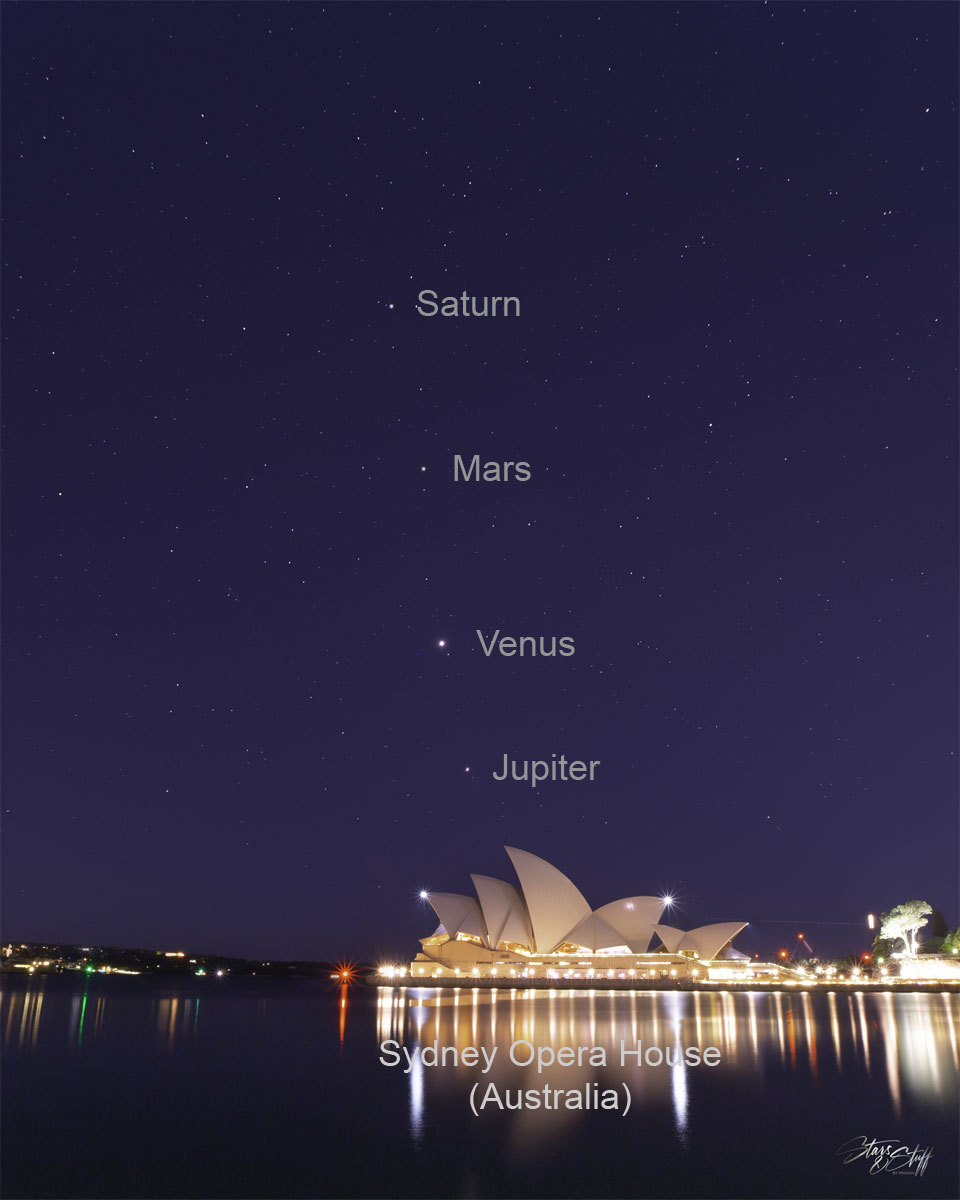
When two planets pass on the night sky, they can usually be seen near each other for a week or more. In the case of this planetary conjunction, Venus and Mars passed within 4 degrees of each other earlier this month. The featured image was taken a few days prior, when Venus was slowing rising in the pre-dawn sky, night by night, while Mars was slowly setting. The image, a four-part mosaic, was captured in Brazil from the small town Teresópolis. Besides Venus and Mars, the morning sky now also includes the more distant planet Saturn. Of course, these conjunctions are only angular — Venus, Mars, and Saturn continue to orbit the Sun in very different parts of our Solar System. Next week, the angle between Saturn and Mars will drop to below a quarter of a degree. [via NASA] https://ift.tt/1sC0AOr

Gems of a Maldivean Night

The southernmost part of the Milky Way contains not only the stars of the Southern Cross, but the closest star system to our Sun — Alpha Centauri. The Southern Cross itself is topped by the bright, yellowish star Gamma Crucis. A line from Gamma Crucis through the blue star at the bottom of the cross, Acrux, points toward the south celestial pole, located just above the small island in the featured picture — taken in early March. That island is Madivaru of the Maldives in the Indian Ocean. Against faint Milky Way starlight, the dark Coal Sack Nebula lies just left of the cross, while farther left along the Milky Way are the bright stars Alpha Centauri (left) and Beta Centauri (Hadar). Alpha Centauri A, a Sun-like star anchoring a three-star system with exoplanets, is a mere 4.3 light-years distant. Seen from Alpha Centauri, our own Sun would be a bright yellowish star in the otherwise recognizable constellation Cassiopeia. [via NASA] https://ift.tt/n0BFCMX

Titan Seas Reflect Sunlight

Why would the surface of Titan light up with a blinding flash? The reason: a sunglint from liquid seas. Saturn’s moon Titan has numerous smooth lakes of methane that, when the angle is right, reflect sunlight as if they were mirrors. Pictured here in false-color, the robotic Cassini spacecraft that orbited Saturn from 2004 to 2017 imaged the cloud-covered Titan in 2014 in different bands of cloud-piercing infrared light. This specular reflection was so bright it saturated one of Cassini’s infrared cameras. Although the sunglint was annoying — it was also useful. The reflecting regions confirm that northern Titan houses a wide and complex array of seas with a geometry that indicates periods of significant evaporation. During its numerous passes of our Solar System’s most mysterious moon, Cassini has revealed Titan to be a world with active weather — including times when it rains a liquefied version of natural gas. [via NASA] https://ift.tt/SaREW8b

Pluto at Night

The night side of Pluto spans this shadowy scene. In the stunning spacebased perspective the Sun is 4.9 billion kilometers (almost 4.5 light-hours) behind the dim and distant world. It was captured by far flung New Horizons in July of 2015 when the spacecraft was at a range of some 21,000 kilometers from Pluto, about 19 minutes after its closest approach. A denizen of the Kuiper Belt in dramatic silhouette, the image also reveals Pluto’s tenuous, surprisingly complex layers of hazy atmosphere. Near the top of the frame the crescent twilight landscape includes southern areas of nitrogen ice plains now formally known as Sputnik Planitia and rugged mountains of water-ice in the Norgay Montes. [via NASA] https://ift.tt/c9FGAyJ

The Medusa Nebula

Braided and serpentine filaments of glowing gas suggest this nebula’s popular name, The Medusa Nebula. Also known as Abell 21, this Medusa is an old planetary nebula some 1,500 light-years away in the constellation Gemini. Like its mythological namesake, the nebula is associated with a dramatic transformation. The planetary nebula phase represents a final stage in the evolution of low mass stars like the sun as they transform themselves from red giants to hot white dwarf stars and in the process shrug off their outer layers. Ultraviolet radiation from the hot star powers the nebular glow. The Medusa’s transforming star is the faint one near the center of the overall bright crescent shape. In this deep telescopic view, fainter filaments clearly extend above and left of the bright crescent region. The Medusa Nebula is estimated to be over 4 light-years across. [via NASA] https://ift.tt/gqpIx7l

Arp 78: Peculiar Galaxy in Aries

Peculiar spiral galaxy Arp 78 is found within the boundaries of the head strong constellation Aries. Some 100 million light-years beyond the stars and nebulae of our Milky Way galaxy, the island universe is over 100,000 light-years across. Also known as NGC 772, it sports a prominent, outer spiral arm in this detailed cosmic portrait from the large Gemini North telescope near the summit of Maunakea, Hawaii, planet Earth. Tracking along sweeping dust lanes and lined with young blue star clusters, Arp 78’s spiral arm is likely pumped-up by galactic-scale gravitational tidal interactions The close companion galaxy responsible is NGC 770, located off the upper right of this frame. But more distant background galaxies are clearly visible in the cosmic field of view. [via NASA] https://ift.tt/9IV3WH7